The most effective energy-saving sensor is not simply the one that switches lights off fastest. It is a system that detects the activity taking place without making users wave their hands repeatedly. When automatic lighting becomes disruptive, people often find ways to disable it permanently.
At a glance
A guide to selecting PIR, microwave, and dual-technology sensors and setting detection coverage, timeouts, and manual overrides for offices, meeting rooms, and occasionally used spaces.
Design principles to establish first
Start with the activities, users, and actual conditions in the space. Then define measurable criteria, including illuminance on the relevant planes, uniformity, glare, color quality, and energy use. Select luminaires to meet those requirements rather than starting with an available product model.
Match sensor technology to the activity
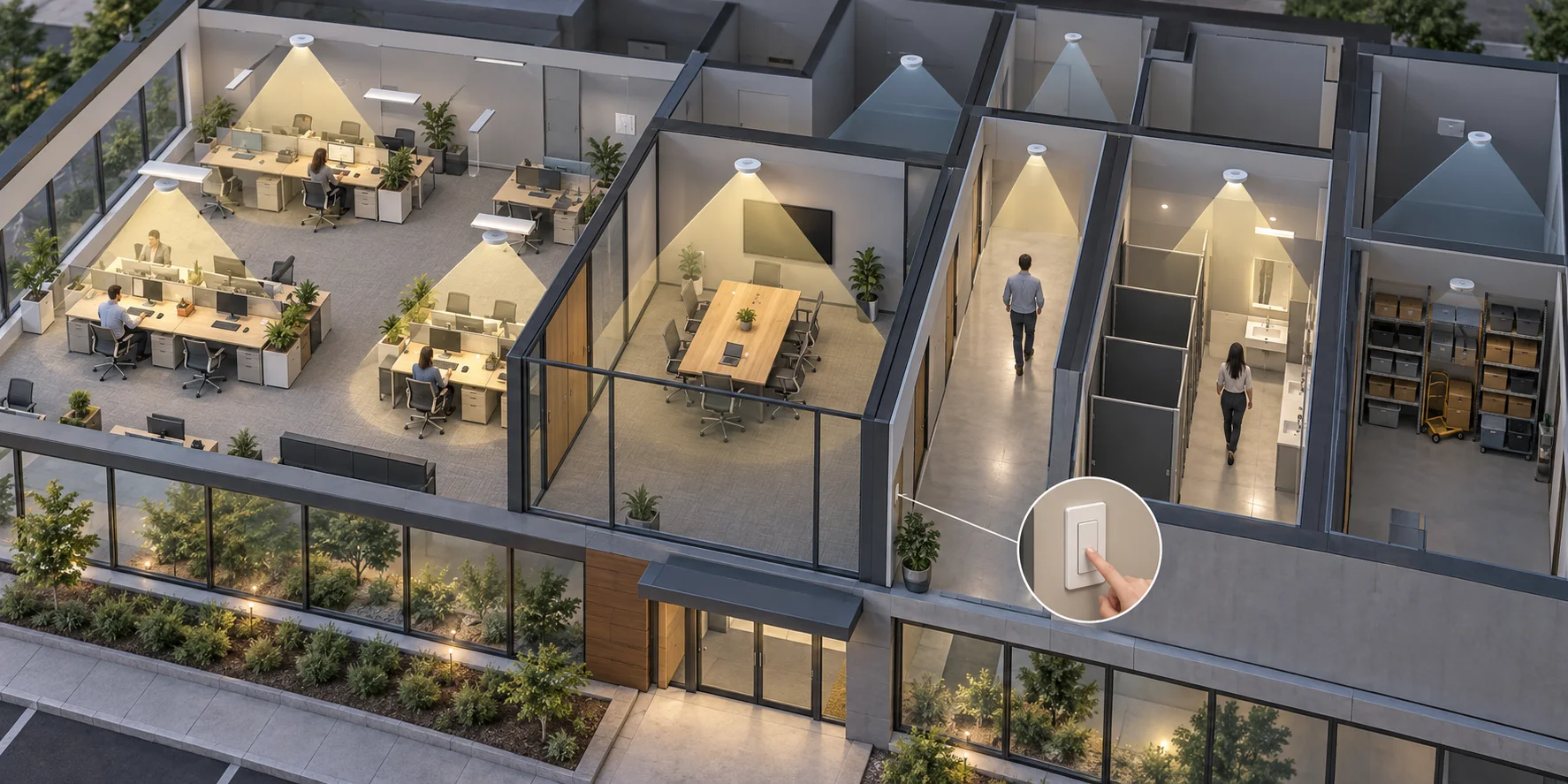
PIR sensors detect movement within their line of sight. Microwave sensors can be more sensitive and may detect movement through certain materials, so false triggering needs careful consideration.
Plan detection coverage using manufacturer data
Use the manufacturer’s detection coverage diagrams. Check mounting height, partitions, doors, and the positions where people will sit relatively still.
Configure how the system behaves
Set the timeout, minimum light level, fade behavior, and manual-on/auto-off operation to suit each room. Avoid applying the same settings throughout the building.
Recommended workflow
- Survey the space and record architectural, electrical, and maintenance constraints.
- Establish design criteria and divide the space into zones according to activity.
- Calculate or simulate lighting and check performance on the planes relevant to users’ actual visual tasks.
- Build a mock-up in areas where problems are likely, then refine the optical distribution, equipment positions, and controls.
- Measure performance after installation, record commissioning settings, and hand over instructions for maintaining the system.
Pre-handover checklist
- Carry out a walk test after installation.
- Avoid locations where air-conditioning drafts or doors could cause false detection.
- Keep a log of problems during the first month and adjust settings accordingly.
Frequently asked questions
Should I start with lux levels or choose luminaires first?
Start with the visual tasks and lighting quality criteria. Then choose luminaires and positions that meet those criteria with appropriate energy use and cost.
Can manufacturer specifications replace on-site measurements?
Not entirely. Datasheets support calculations and product selection, but actual performance depends on mounting distances, surface colors, obstructions, supply voltage, and system settings. Take measurements after installation.
References and further reading
Thai source reviewed: September 28, 2026. English translation: October 10, 2026.
ทางลัดสำหรับวางแผนแสงสว่าง
เริ่มจากรวมบทความ เลือกเครื่องมือคำนวณ แล้วดูวิธีทดสอบหรือแหล่งเลือกโคมที่เกี่ยวข้อง