
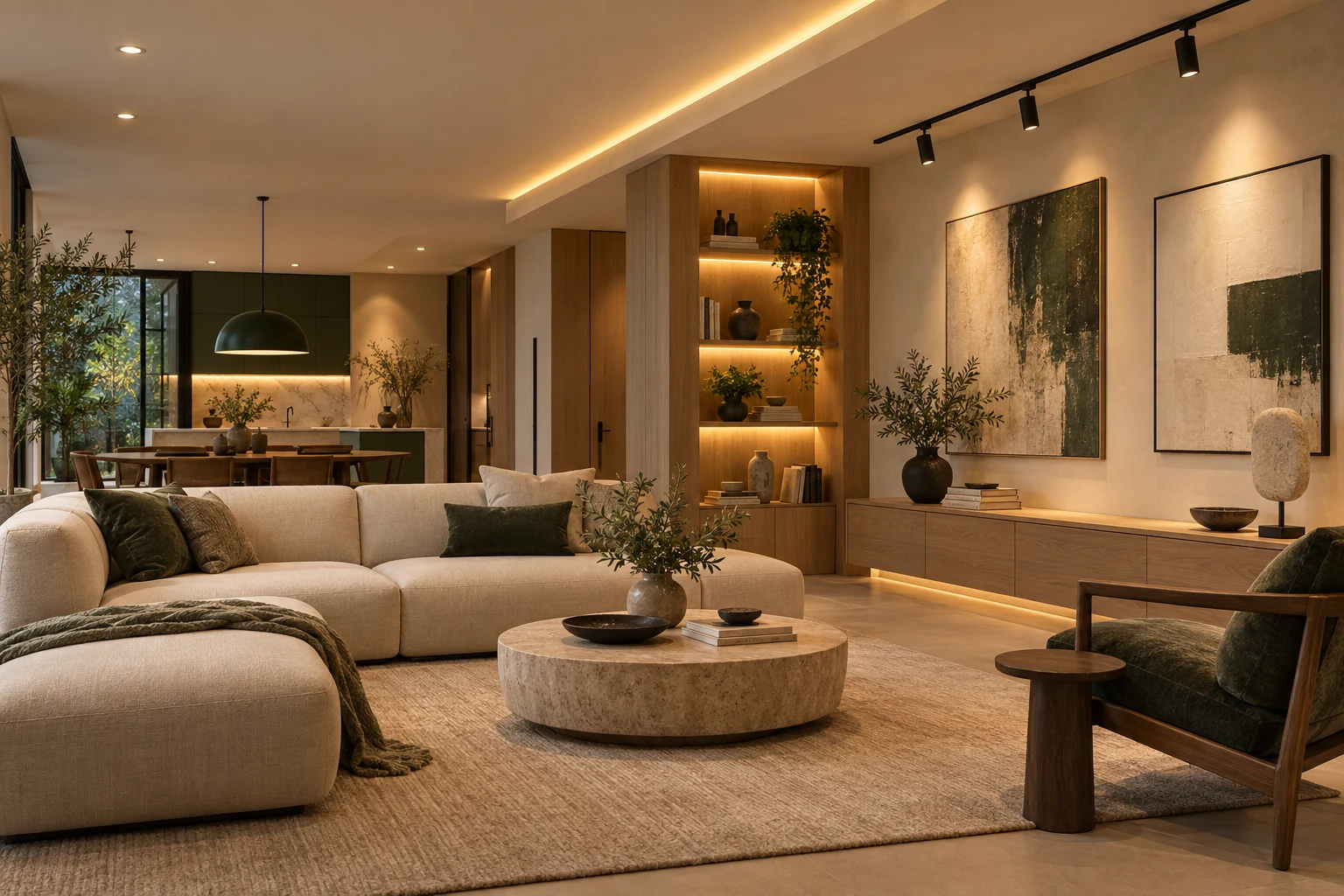
Downlights, track lights and LED strips differ in how they are installed and how they deliver light to a space. Downlights suit a clean ceiling appearance; track lights make it easier to aim and reposition accent lighting; LED strips provide continuous light for under-cabinet and concealed installations. All three can work together. None is automatically brighter, more efficient or more comfortable without considering its specifications and installation.
This guide compares benefits, limitations, suitable applications and purchasing checks for homes, apartments and shops. It also includes an LED strip load calculation you can discuss with a supplier.
Prepared for Lumens Lab · English translation of the Thai article, whose references were reviewed on 6 October 2026 · Lighting layouts and calculations are illustrative examples, not product test results.
Downlights vs track lights vs LED strips: comparison
This table compares typical applications, not the quality of every product on the market. Downlights may be recessed or surface-mounted. Track systems may support spotlights, downlights and wallwashers, so check the light distribution of the actual model. [1]
| Type | Benefits | Limitations | Suitable applications | Check before buying |
|---|---|---|---|---|
| Downlights | A clean ceiling appearance; lens options for broad or focused light | Recessed models need a cutout and ceiling clearance; difficult to relocate; bright exposed sources may cause glare | General lighting, corridors, entrance halls and areas with relatively fixed layouts | Cutout size, recess depth, ventilation clearances, beam angle, source shielding and driver access |
| Track lights | Heads can be aimed and moved along compatible track; accents can follow changing displays | Visible track and fixtures; careful aiming required; different brands or voltage systems may be incompatible | Shops, artwork, display walls, multipurpose rooms and frequently changing layouts | Track, adapter, voltage, control circuits, load rating, beam angle and aiming range |
| LED strips | Continuous linear light; easily concealed in joinery; suitable for narrow spaces | Require coordinated power, thermal and wiring design; LED dots may be visible; the far end may appear dimmer | Under-cabinet lighting, display shelves, ceiling coves and decorative lines of light | Voltage, W/m, lm/m, maximum run length, cutting points, profiles, diffusers and maintenance access |
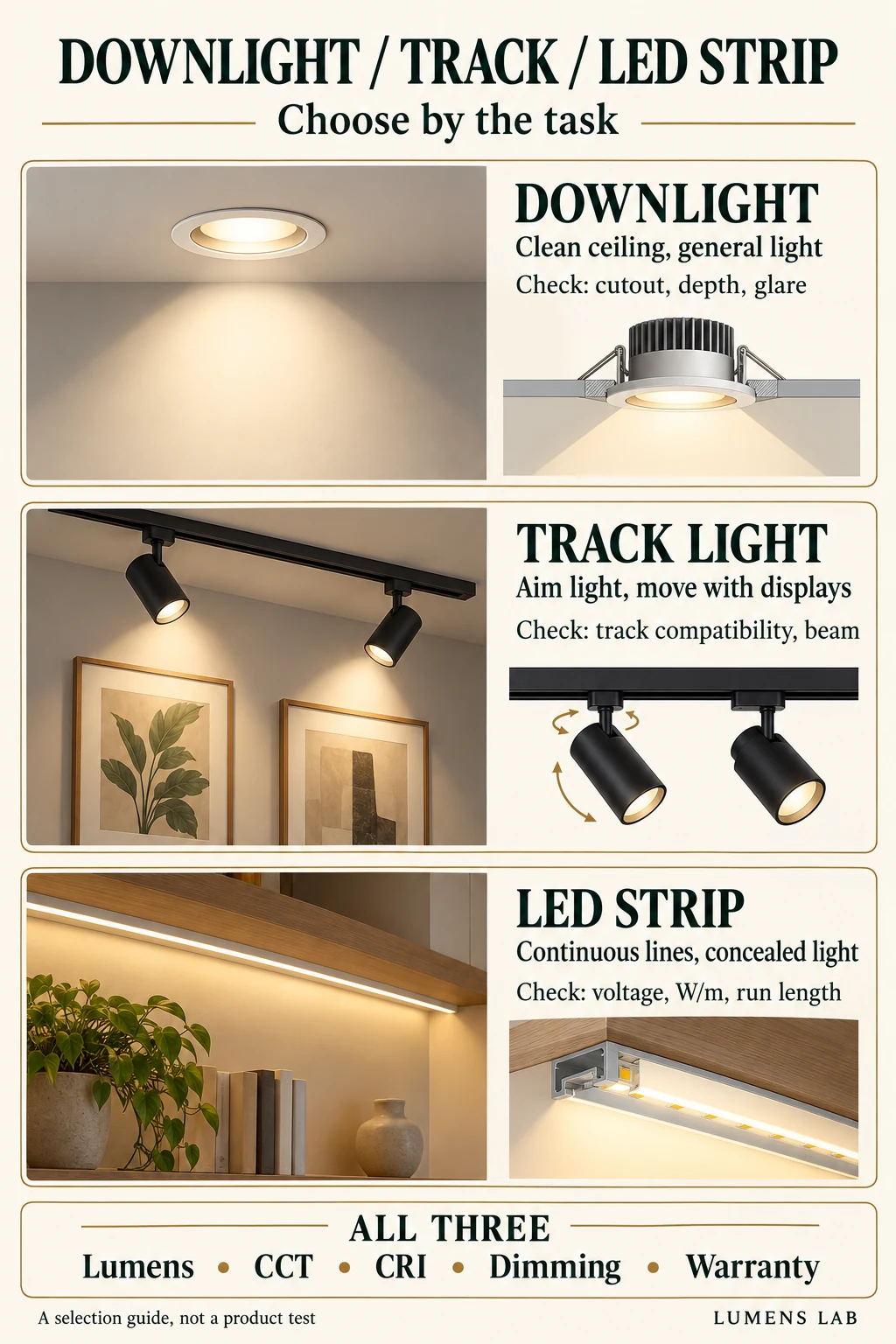
Visual guide: choose by the role of the light
When are downlights suitable, and what should you watch for?
Downlights direct light downward from above the working or occupied area. Wide distributions suit general lighting, while narrow or adjustable models can highlight objects. Do not assume every downlight produces the same result, or use wattage instead of photometric information. [2]
Look beyond the fixture’s appearance and consider glare. Good source shielding reduces direct views of bright components, but comfort also depends on fixture position, sightlines and reflective surfaces. An “anti-glare” claim should be supported by distribution data or a physical sample trial. [3]
- Replacing an existing fixture: measure the actual cutout and ceiling void depth, not just the outer trim diameter.
- Above a sofa or bed: assess the view from sitting and reclining positions, rather than judging the room only while standing.
- Recessed installations: follow the manufacturer’s instructions for insulation, clearances and ventilation, and leave access to the driver.
Track lights suit spaces where lighting needs to follow the display
Track luminaires connect to an electrical track. Their main advantage is flexibility within a compatible system: heads can be repositioned and re-aimed when merchandise moves, subject to the manufacturer’s instructions. Track systems are not limited to spotlights; some also support general lighting and wallwashing. [1]
Do not buy track and heads separately based on appearance alone. Ask the supplier to confirm compatible model numbers, including adapters, voltage, circuit configuration, connectors and controls. Low-voltage magnetic track and mains-voltage track are different systems; similar looks do not make them interchangeable.
- Artwork or merchandise: match the beam footprint to the object and test from the viewer’s position to avoid reflections.
- Low ceilings: check how far the installed head projects and whether its bright face is visible from circulation routes.
- Frequently changing shop layouts: allow for track and control zones, but check load ratings and fixing points before adding heads.
LED strips provide continuous light, but must be selected as a system
LED strips consist of light sources arranged along a circuit strip. This article focuses on constant-voltage indoor products, such as 12 V or 24 V strips. Mains-voltage and specialised control products require their own model-specific instructions. Compare lumens per metre (lm/m) and watts per metre (W/m) together with the required length, rather than just the price of a reel. [4]
Under-cabinet installations should deliver light to the work surface while keeping the source out of direct view. Cove lighting depends on the colour and distance of reflecting surfaces. Not all the strip’s light reaches the worktop, so its raw lumen output is not the same as useful illuminance at the task.
A bright beginning and a dimmer far end may indicate voltage drop. Check the maximum permitted run length, cable length and size, and the specified power-feed arrangement. Do not address the problem simply by extending the strip or raising the supply above the strip’s rated voltage. [5]
Aluminium profiles provide mounting support and heat transfer. Diffusers spread the light but may reduce transmitted output. Thermal requirements depend on the strip’s power and construction. Follow the product instructions rather than assuming every strip either requires or does not require a heat-dissipating channel. [6]
Buying checklist: ask the supplier for these nine things
- Lumens and light distribution: watts describe power consumption, lumens describe light output, and lux at the desk depends on distance, angle and room conditions. Ask for information about the complete luminaire, not only its LED chips. [7]
- Beam angle: a narrow beam can create an accent but does not guarantee uniform lighting across a room. For a real project, inspect the model’s IES/LDT file or photometric curves.
- Light colour (CCT): for a warm atmosphere, you might begin by trying 2700–3000 K; for a more neutral white appearance, try 3500–4000 K. These are starting points for atmosphere, not mandatory rules. A higher Kelvin value does not mean greater brightness.
- Colour rendering: Ra 80 or above may be an initial screening criterion for general applications. Where food, skin or merchandise colours matter, Ra 90 or above may be a starting point, together with R9 data and trials using actual materials. Read our guide to CRI, R9 and TM-30 (Thai) before judging by a single score.
- Dimming and flicker: request a list of compatible dimmers or controllers. Test from full output to low dimming levels and check for noise or unstable light. One phone video is not proof that a light is flicker-free.
- Electrical compatibility: check voltage, current or power ratings and driver type. A constant-current driver used by some downlights cannot replace a constant-voltage supply for an LED strip.
- Installation and environment: specify the cutout, depth, fixing points, thermal conditions, moisture exposure and suitable IP rating for the actual location. Strip cutting points and connectors also need the protection required by the system.
- Model-specific documentation: request the datasheet, photometric report and safety documentation for the exact product. Verify certification marks or numbers with the issuing organisation; a logo on an advertisement is not sufficient evidence on its own.
- Complete-system cost and after-sales support: include luminaires, track or profiles, drivers, dimming equipment, cables, labour, maintenance access and warranty terms. Ask whether the driver or LED module can be replaced separately.
LED strip calculation: sizing a power supply
Assume a 24 V strip rated at 10 W/m, with a total length of 5 metres. The specified strip load is 10 × 5 = 50 W. Approximate total current is 50 ÷ 24 = 2.08 A, before adding any controller or other equipment loads.
If the selected power supply’s instructions limit continuous operation to 80% of its rating under these installation conditions, the minimum rating would be 50 ÷ 0.80 = 62.5 W. Select an available model that also satisfies the actual temperature conditions. The 80% limit is an assumption for this example, not a universal rule for every driver. Allow for additional loads and check the model’s derating curves.
Even when the supply has sufficient capacity, confirm whether the manufacturer permits the 5-metre strip as one run and assess voltage drop in the cables between the supply and strip. Wattage alone is not enough to determine whether the system is suitable. [4] [5]
How can you combine them in homes, apartments and shops?
| Space | Starting approach | Test before buying the full system |
|---|---|---|
| Living room | Downlights for general lighting, supplemented by concealed strips for atmosphere | TV reflections and views from the sofa; separate switching or dimming circuits |
| Kitchen worktop | Downlights for the room, with under-cabinet strips for the work surface | Shadows from the user, worktop reflections and cleaning access to the profile |
| Clothing shop or café | Track lights to accent merchandise and walls, with general lighting as needed | Product colours, bright sources visible from aisles, and re-aiming when shelves move |
| Apartment with limited ceiling alterations | Consider surface-mounted downlights or track compatible with the existing fixings and electrical system | Headroom, cable routes, building restrictions and maintenance access |
Start with three roles: general lighting for movement and everyday use, task lighting to see what you are doing, and accent lighting to draw attention. A room does not necessarily need all three fixture types if the chosen fittings already fulfil the required roles. See more examples in our retail lighting layers guide (Thai).
Common mistakes that lead to rework
- Buying by matching wattage: two products using the same power may produce different lumen outputs and distributions.
- Placing downlights on a grid without considering furniture: this can brighten circulation areas while leaving shadows on task surfaces.
- Selecting track before selecting heads: the components may not fit together or may not support the intended dimming method.
- Buying strips without accounting for accessories: a low price per metre may exclude drivers, profiles, cables and installation labour.
- Concealing drivers where they cannot be serviced: provide suitable access and ventilation in accordance with the instructions.
- Judging from product photographs: cameras and screens alter perceived brightness and colour. Test samples with the actual materials.
Frequently asked questions
Are downlights or track lights brighter?
It depends on the models and the task. A narrow-beam track light may create high lux on merchandise without making the whole room brighter than downlights would. Compare lumen output, distribution, mounting distance and illuminance on the intended surface together.
Can LED strips be the main lighting in a room?
Yes, if output, installation and distribution are designed to provide enough useful light. Concealed mood lighting does not automatically replace task lighting. Calculate and measure illuminance at the actual working area.
Can track lights replace downlights?
In some applications, provided the heads and distributions are suitable for general lighting. Check uniformity and glare. The same number of fixtures does not guarantee the same result.
Should I choose 12 V or 24 V LED strips?
Match the strip to its power supply and controller. At the same power, a 24 V system draws less current than a 12 V system, which may help manage voltage drop. Maximum run length still depends on the strip and cable design. Never connect a 12 V strip to a 24 V supply.
Which is most energy-efficient: downlights, track lights or LED strips?
The fixture type alone does not answer this. Compare total power needed to achieve the same required lighting level and quality for the same task, including driver losses, operating hours and controls.
Can a dimmable fixture work with my existing dimmer?
Not necessarily. Check the dimming method and compatibility of the complete system, including minimum and maximum loads. Test the actual dimming range before buying in quantity.
Bring a room layout and specification checklist before ordering
Record room dimensions, ceiling height, furniture positions, visual tasks and existing electrical points. Ask the supplier for a complete equipment list and a sample luminaire. Trying one location before ordering for the entire room helps reveal beam coverage, colour, reflections and dimming performance.
Use our preliminary lighting calculator (Thai) to estimate lighting requirements, and consult our luminaire and test-data guide (Thai). Mains wiring, protective-device selection and installation should be checked by a qualified electrician against actual site conditions and applicable requirements.
References and scope
- ERCO — Track and singlets: track system construction and compatible luminaire types.
- ERCO — Recessed downlights: recessed luminaire types and light distributions.
- ERCO Lighting Knowledge — Shielding angle: shielding and visual comfort.
- Waveform Lighting — LED Flex Strip Support: voltage, power supplies and strip connection requirements.
- Waveform Lighting — What is LED strip voltage drop?: causes and ways to manage voltage drop.
- Waveform Lighting — Aluminum Channels for LED Strip Lights: profiles, diffusers and heat transfer.
- U.S. Federal Trade Commission — Shopping for Light Bulbs: distinguishing lumens from watts and interpreting buying information.
Manufacturer sources support explanations of technology; they do not constitute product endorsement or establish cross-brand compatibility. Selection values and layout examples are guidance for this article. Check the exact product instructions and site conditions before installation. Illustrations explain concepts rather than showing measured test results.
ทางลัดสำหรับวางแผนแสงสว่าง
เริ่มจากรวมบทความ เลือกเครื่องมือคำนวณ แล้วดูวิธีทดสอบหรือแหล่งเลือกโคมที่เกี่ยวข้อง