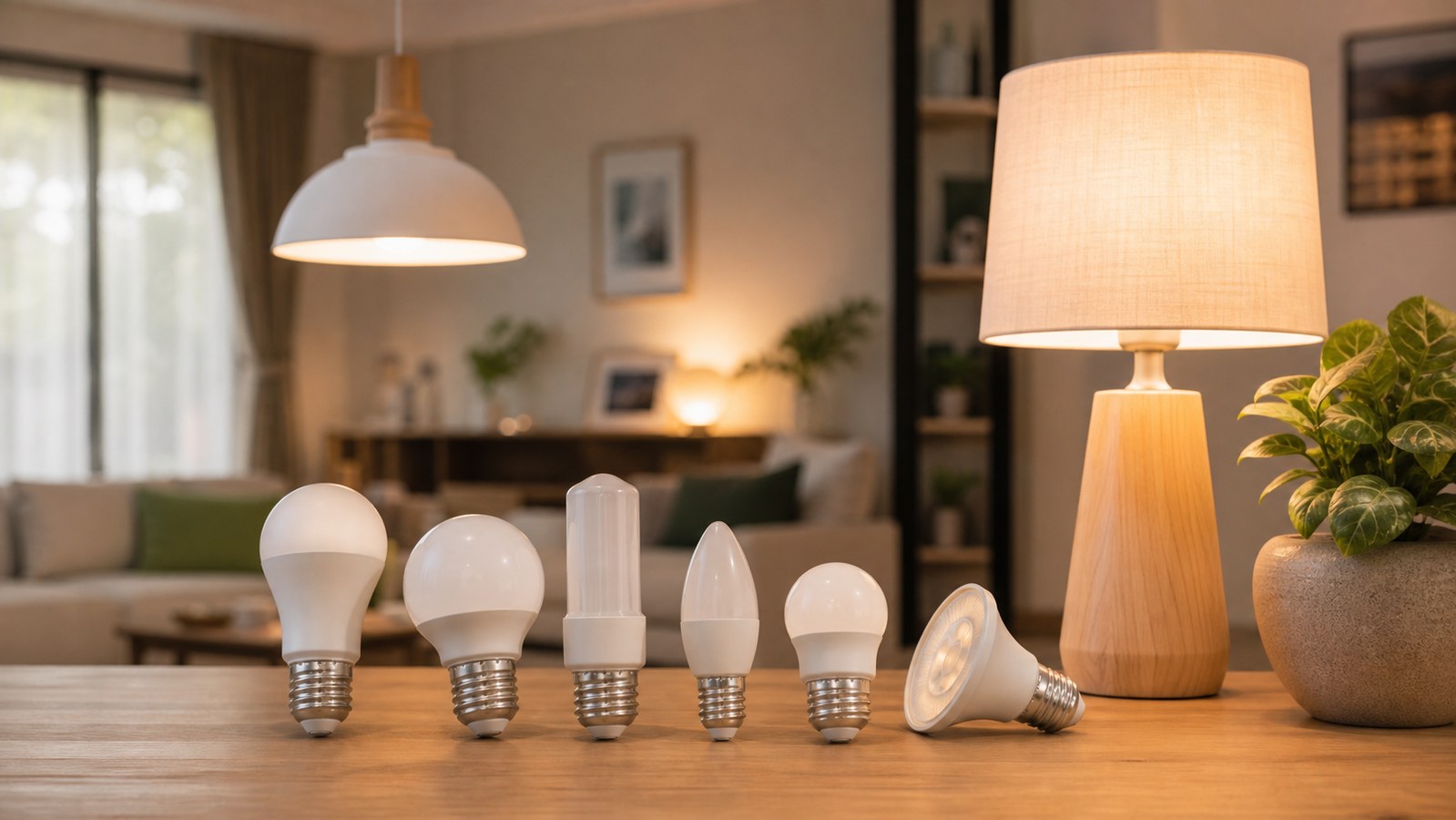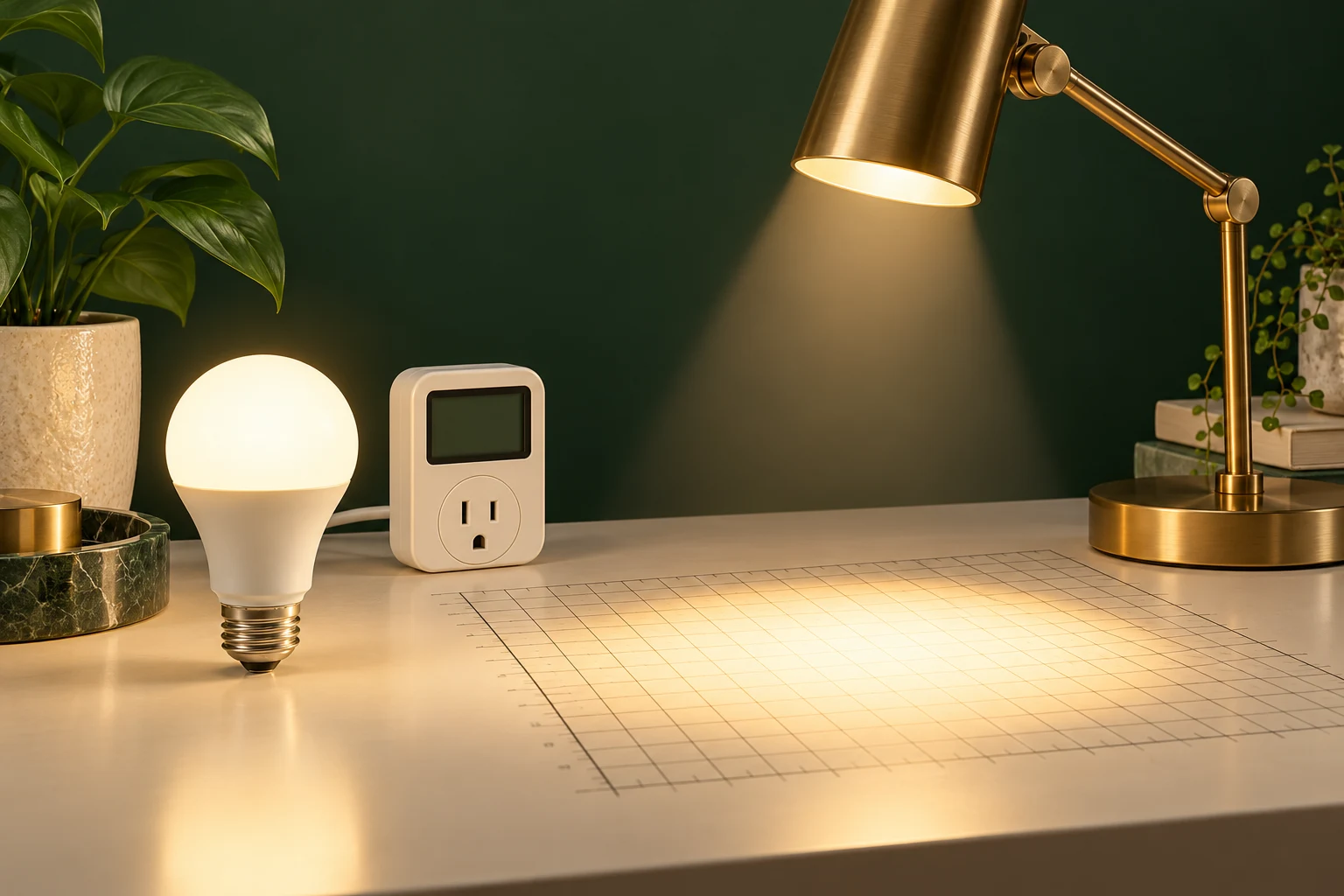
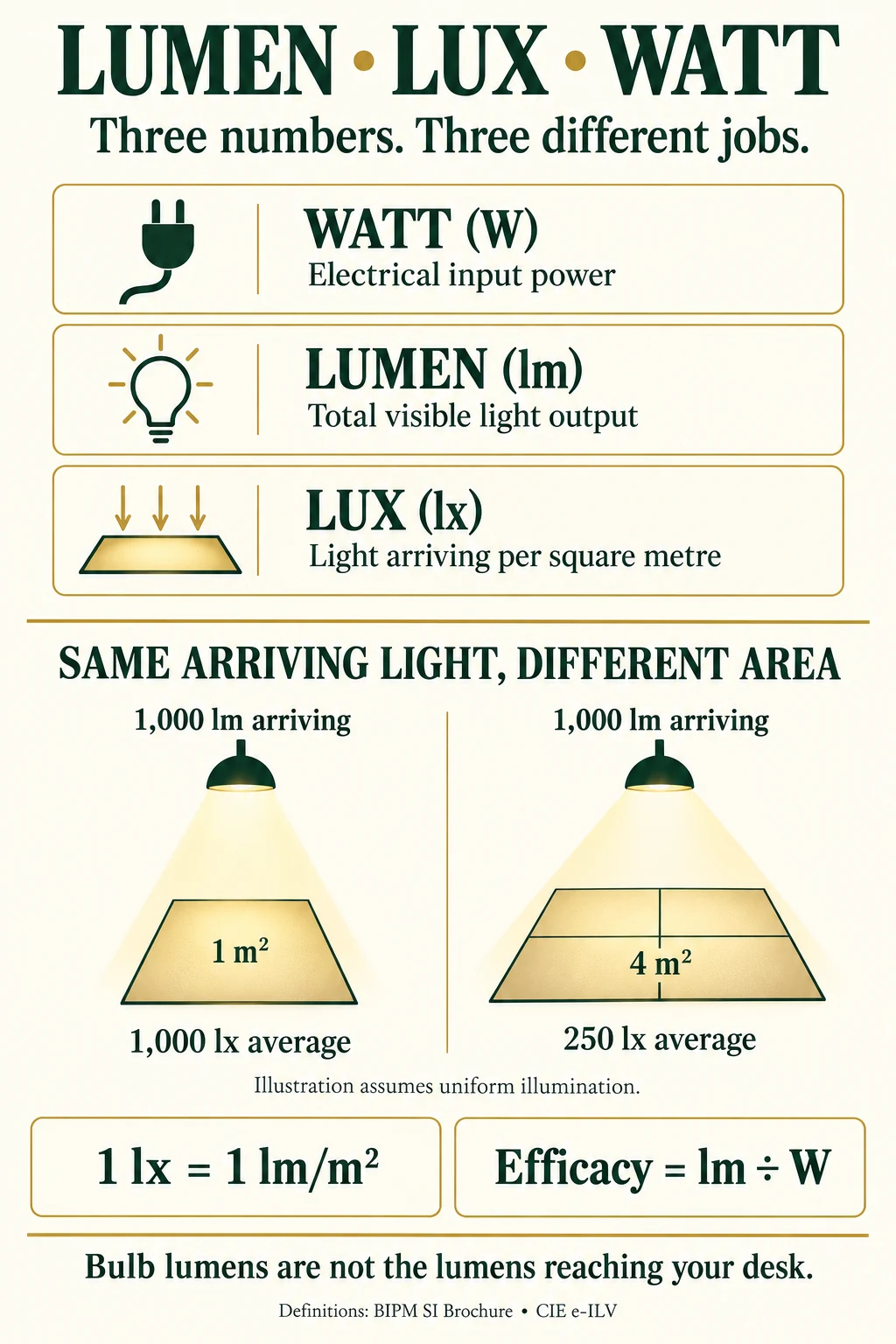
Lumens, lux and watts describe three different things. Watts (W) measure electrical input power, lumens (lm) measure visible light output, and lux (lx) measure light arriving on a surface per square metre. Choose a bulb by its lumen output, compare its power demand in watts, then check illuminance where the light is actually needed.
Two 800 lm bulbs can draw different wattages and produce different lux readings on a desk. The fitting, beam distribution, distance and position all matter. These units are not interchangeable.
Lumens vs lux vs watts at a glance
| Unit | What it measures | What to use it for |
|---|---|---|
| Watt (W) | Electrical input power | Comparing power demand and calculating energy use |
| Lumen (lm) | Luminous flux: total visible light output | Comparing bulb or complete luminaire output |
| Lux (lx) | Illuminance on a surface | Checking light at the working area |
The unit definitions follow the BIPM SI Brochure and CIE e-ILV definition of illuminance: 1 lx = 1 lm/m². Perceived brightness also depends on surface appearance, contrast and the surroundings; it is not simply another name for one of these measurements.
Infographic: the same arriving light over a larger area
What are watts, and how do they relate to electricity use?
A watt measures power, the rate of energy use. A 9 W bulb operating for one hour at constant power uses 9 Wh. Electricity consumption is normally recorded in kilowatt-hours: 1 kWh = 1,000 Wh. Lower wattage does not automatically mean less light; read the lumen rating alongside it.
A monthly energy example
Energy (kWh) = W × hours per day × days ÷ 1,000
A 9 W bulb used for 5 hours a day over 30 days consumes 1.35 kWh. Ten such bulbs consume 13.5 kWh. Multiply by the applicable unit rate on your electricity bill to estimate the energy charge. This example assumes constant rated power and excludes other loads and standby consumption.
What are lumens? Compare the output you are buying
Luminous flux describes light output weighted for human visual response. It does not directly describe the light reaching a desk. For a replacement bulb, check the bulb’s lumen rating. For an integrated LED fitting, use the output of the complete luminaire, rather than a bare LED-chip figure that may exclude optical losses.
Consider two hypothetical bulbs: A is rated 800 lm at 8 W; B is rated 800 lm at 10 W. Their stated total light output is equal, but A uses less power. Their desk illuminance can still differ if their fittings or light distributions differ.
How many lumens replace an incandescent bulb?
| Old incandescent bulb | Approximate light output |
|---|---|
| 40 W | 450 lm |
| 60 W | 800 lm |
| 75 W | 1,100 lm |
| 100 W | 1,600 lm |
Source: U.S. Department of Energy, Table 2. These are replacement benchmarks for general incandescent lamps, not a universal LED watt-to-lumen conversion. A “60 W equivalent” label is not the LED bulb’s actual electrical input power.
What is lux, and why does the same bulb give different readings?
Lux describes illuminance on a surface, such as a book, counter or corridor floor. A high-output lamp may deliver little light to a desk if it sends light elsewhere or is obstructed. A narrow beam may give a high central reading while leaving the edges dark. Look at the distribution as well as the average.
- Distance and position: changing mounting height or aiming changes the light reaching the same surface.
- Beam distribution: similar total output does not mean equal coverage or equal peak illuminance.
- Surfaces and obstructions: walls, ceilings, shelves and people affect reflected light and shadows.
- Operating conditions: daylight, dimming, dirt and ageing affect the reading.
How do you convert lumens to lux?
Average lux = lumens arriving on the area ÷ area (m²)
If 1,000 lm reach 1 m², the average is 1,000 lx. Spread the same arriving flux over 4 m² and the average is 250 lx. Individual readings will differ from that average when the distribution is uneven.
A common mistake: dividing a 1,000 lm bulb rating by a 10 m² room and concluding that every point receives 100 lx. That ignores light reaching other surfaces, losses and spatial distribution. It does not verify the installed lighting.
A starting estimate for a 12 m² room
Assume an illustrative target of 200 lx, a utilisation factor UF = 0.60 and a maintenance factor MF = 0.80.
Total luminaire output ≈ (200 × 12) ÷ (0.60 × 0.80) = 5,000 lm
At 1,000 lm per fitting, the starting estimate is five fittings. The target, UF and MF here are worked-example assumptions, not universal room requirements or results from a measured installation.
UF needs to match the luminaire data, room geometry and surface reflectances. MF should reflect ageing, the environment and cleaning arrangements; see the maintenance discussion in the Thorn Technical Handbook. This average-light estimate does not check glare, shadows or uniformity. Verify the layout and installed result separately.
Try the Lumens Lab lighting calculator and review its assumptions before turning an estimate into a purchase quantity. The linked tool currently uses the site’s Thai interface.
What does lm/W mean?
Luminous efficacy (lm/W) = lumen output ÷ input watts
In the hypothetical example, 800 lm ÷ 8 W = 100 lm/W, while 800 lm ÷ 10 W = 80 lm/W. The first delivers more total light per watt. That does not by itself establish better colour quality, visual comfort or suitability. Compare like-for-like measurement boundaries: a bare LED package and a complete fitting are different products.
A practical bulb-buying checklist
- Identify the task and surface. Reading light needs to reach the page; circulation lighting needs to reveal the floor and obstacles.
- Start with lumens. Use a satisfactory existing bulb as an output reference, then compare W and lm/W.
- Check the fitting. Match base, physical size, voltage, thermal conditions and any enclosed-fixture restrictions.
- Consider light quality. CCT describes colour appearance; CRI helps assess colour rendering. Neither substitutes for lm or lx.
- Try the position before buying in quantity. Check desk shadows, screen reflections and comfort from the user’s seat.
- Measure after installation. Check multiple positions on the working surface, not only the brightest spot.
How should you measure lux?
Use an illuminance meter suited to the light source, with appropriate calibration when reference measurements are required. Place its sensor on the relevant working plane and avoid shading it with your body. Record location, sensor height, blinds, time and dimming setting. Compare several points under repeatable conditions. Control daylight when assessing electric lighting alone.
Select the target according to the task and the standards applicable to the project. A single lux reading does not establish compliance. A specialised task value, such as illumination of a surgical field, must not be used as a whole-room ambient target. Phone apps can help with rough exploration when their limitations are understood; they are not automatically suitable for acceptance measurements.
Frequently asked questions
How many lumens are in one watt?
There is no fixed conversion. You need the product’s luminous efficacy. At an assumed 100 lm/W, 1 W corresponds to 100 lm; real products vary.
How many lux is 800 lumens?
The bulb rating alone is insufficient. If all 800 lm arrive on 2 m², the average is 400 lx. A real installation requires the flux actually reaching that area.
Is a 9 W LED always equivalent to a 60 W incandescent?
No. Check whether its rated output is around 800 lm and consider the fitting’s light distribution.
Do more lumens mean more comfortable lighting?
Not necessarily. Glare and screen reflections can make a bright installation uncomfortable. Adjust position, shielding and distribution as well as output.
Should I add bulbs or use a task light?
If the room’s general lighting is adequate but the desk is dark, try a task light or a better position first. Increasing whole-room output may consume more energy without removing the desk shadow.
Put the numbers to work
- How to choose E27 bulbs for your home
- Downlights vs track lights vs LED strips
- Lighting calculators (Thai interface)
Updated 8 October 2026. This guide explains principles using the sources below. Calculations are hypothetical examples, not product tests or certification. See the Lumens Lab methodology (Thai).
Sources
ทางลัดสำหรับวางแผนแสงสว่าง
เริ่มจากรวมบทความ เลือกเครื่องมือคำนวณ แล้วดูวิธีทดสอบหรือแหล่งเลือกโคมที่เกี่ยวข้อง