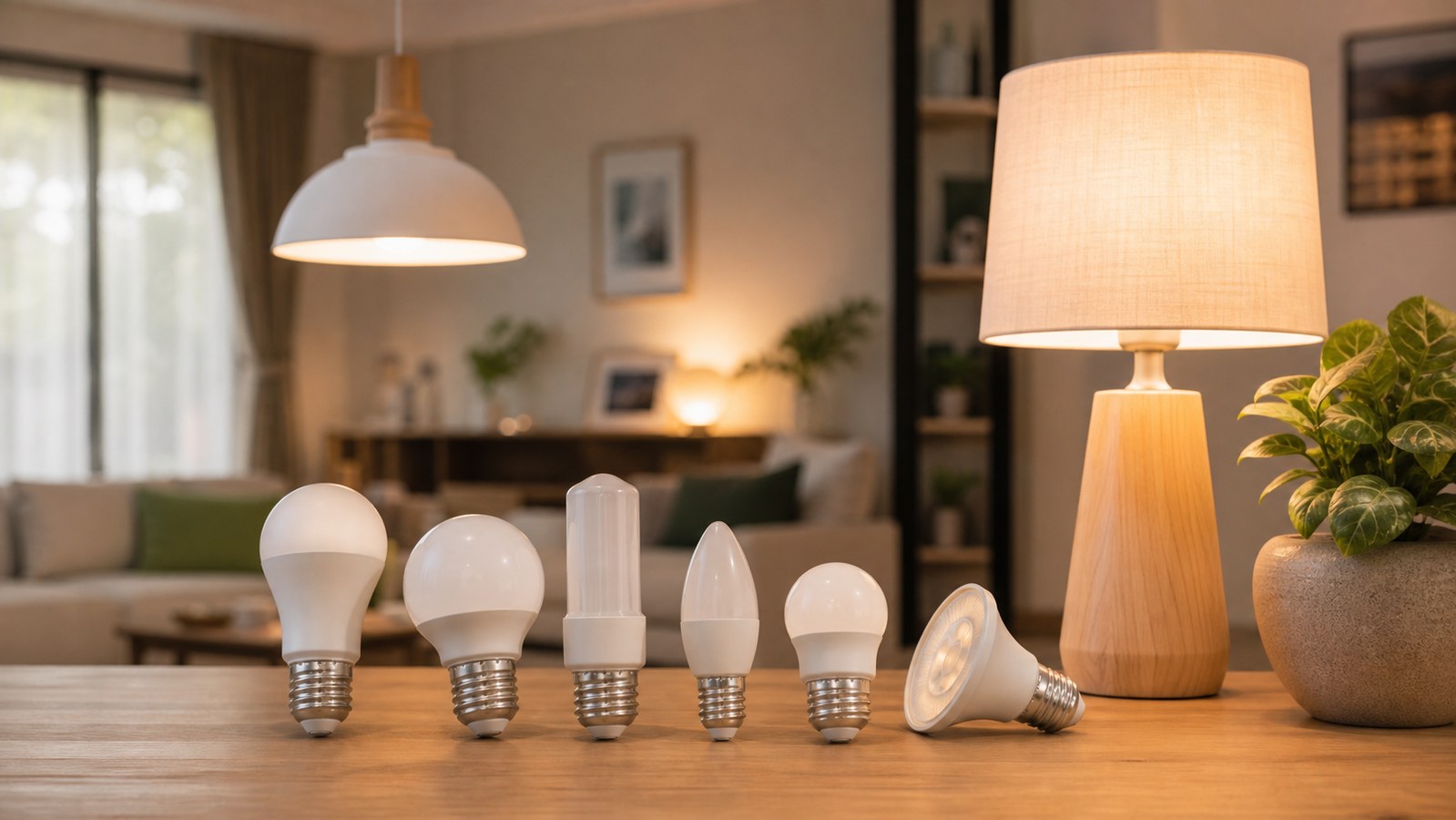
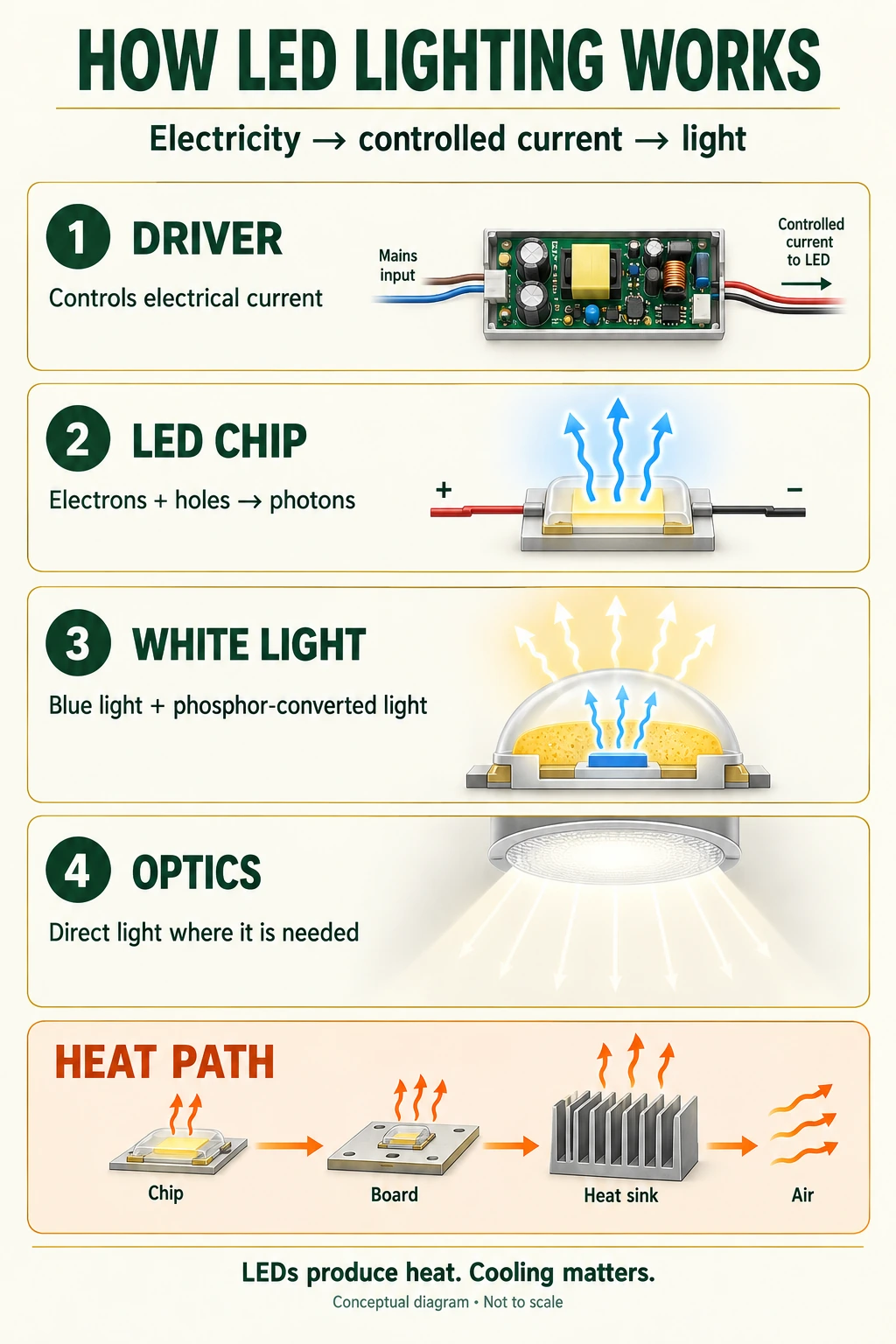
How does an LED work? An LED, or light-emitting diode, produces light in a semiconductor. With the appropriate forward bias, electrons and holes recombine in the emitting region and release photons. A household LED lamp is more than the chip: it also needs current control, a path for heat to escape, and optics that put the light to use.
Heat takes a separate route through the circuit board and housing. Light output, comfort and useful life depend on the complete system, not simply the wattage or chip brand.
What is an LED? The light-emitting principle
A P–N junction joins semiconductor regions with different charge carriers. Forward bias brings electrons and holes into the active region, where recombination can release energy as photons. This is electroluminescence. The semiconductor material and its energy structure influence the emitted wavelength. See ROHM’s introduction to LED devices.
An incandescent lamp heats a filament until it glows. An LED generates light directly in the semiconductor, but does not convert all input energy into light. LEDs still generate heat and need thermal management.
Infographic: from electricity to useful light
How can a blue LED produce white light?
Many general-lighting LEDs combine a blue emitter with phosphor. The phosphor absorbs some of the blue light and re-emits it at longer wavelengths. This mixes with the remaining blue to appear white. Different phosphor mixtures produce different spectra; it is more than a fixed blue-plus-yellow recipe.
Other systems mix several LED colours, such as red, green and blue, or combine colour mixing with phosphor conversion. The DOE LED Basics guide describes these approaches.
Buying implication: CCT describes colour appearance, while CRI and other colour-rendering data help assess object colours. Matching CCT does not ensure identical spectra or rendering. For skin, food or finish samples, compare the actual materials under the proposed light.
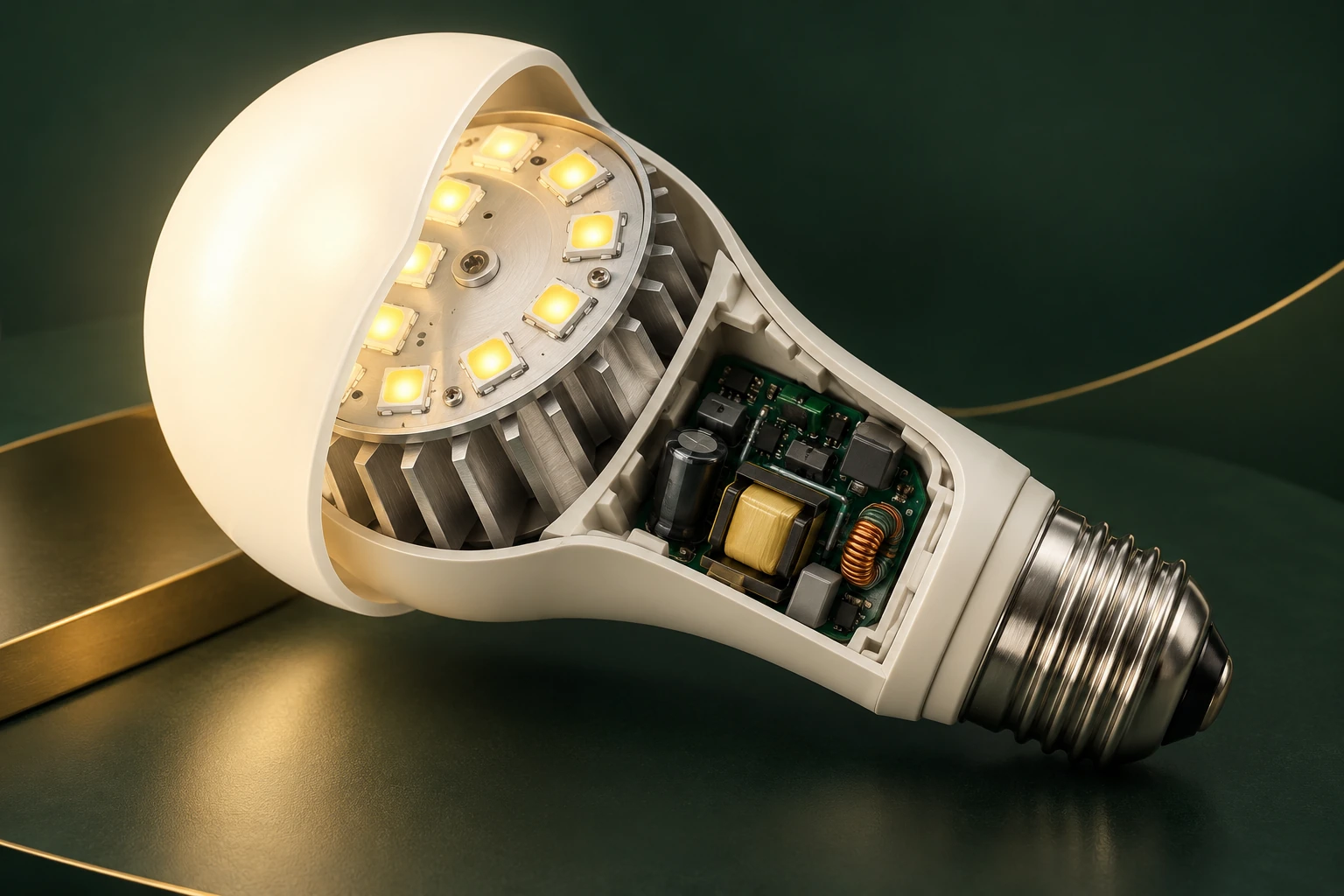
What is inside an LED lamp?
| Part | Job | What to check |
|---|---|---|
| LED chips and packages | Generate light | Output, colour and drive conditions |
| Driver | Manage electrical supply and LED current | Input voltage, output current, dimming and flicker data |
| Board and thermal path | Carry heat away from the chips | Operating temperature and enclosed-fixture suitability |
| Lens, reflector or diffuser | Shape the distribution | Beam angle, bright spots and task shadows |
| Base and housing | Connect, support and protect components | Base type, size and environmental rating |
These parts may be integrated into a bulb or split between a luminaire and external driver. The cover is a conceptual cutaway, not a teardown or test of a specific model.
What does an LED driver do? Why are some lamps not dimmable?
A mains-powered driver converts the supply and manages current through the LED assembly. A system already supplied with DC may not need AC-to-DC conversion. Screw-base household lamps commonly contain their own driver.
Dimming can adjust current amplitude or use pulses with a variable on-time, known as PWM. Texas Instruments’ LED driver resources cover these approaches. The LED label alone does not establish dimmer compatibility: check the lamp’s dimmable rating and the supported control system.
When replacing a driver, match output type, current, voltage range, power and control interface. Equal wattage alone is insufficient. A strip designed for a constant-voltage supply is different from a module requiring constant current. Have mains electrical work performed by a qualified installer; do not open a lamp while it is connected to power.
Why does an efficient LED lamp still feel hot?
Heat must pass from the chip through its mounting, board, interface materials and housing to the surroundings. A poor thermal path raises junction temperature and can affect output, colour and reliability. Cree LED’s thermal-management application note explains this relationship.
Check enclosed-fixture suitability before placing a lamp inside a sealed shade, and follow clearance and ventilation instructions. Surface temperature alone does not reveal the chip’s internal temperature or establish product quality.
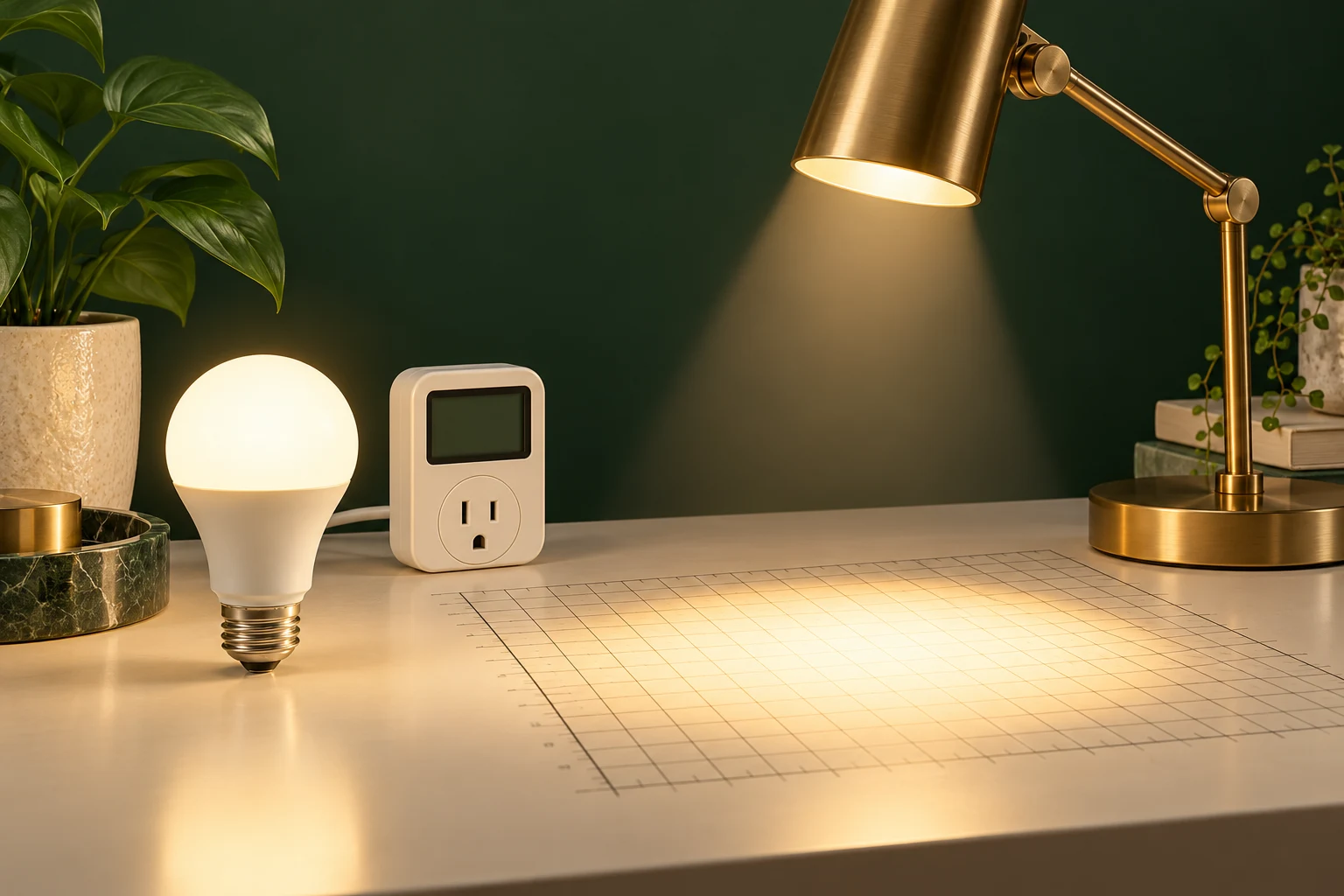
How should you compare light output and electricity use?
Use complete lamp or luminaire lumens divided by input watts. Do not compare a bare-chip figure with a finished product rating. For the units, see lumens vs lux vs watts.
Worked example: equal output, different power
Lamp A: 900 lm / 9 W = 100 lm/W
Lamp B: 900 lm / 12 W = 75 lm/W
Ten lamps used for 5 hours a day over 30 days consume 13.5 kWh for A and 18 kWh for B: a difference of 4.5 kWh per month. Multiply by the applicable electricity unit rate to estimate the energy-charge difference.
These hypothetical figures illustrate the calculation, not measured products. They assume full rated power throughout. Also compare colour, beam distribution and visual comfort.
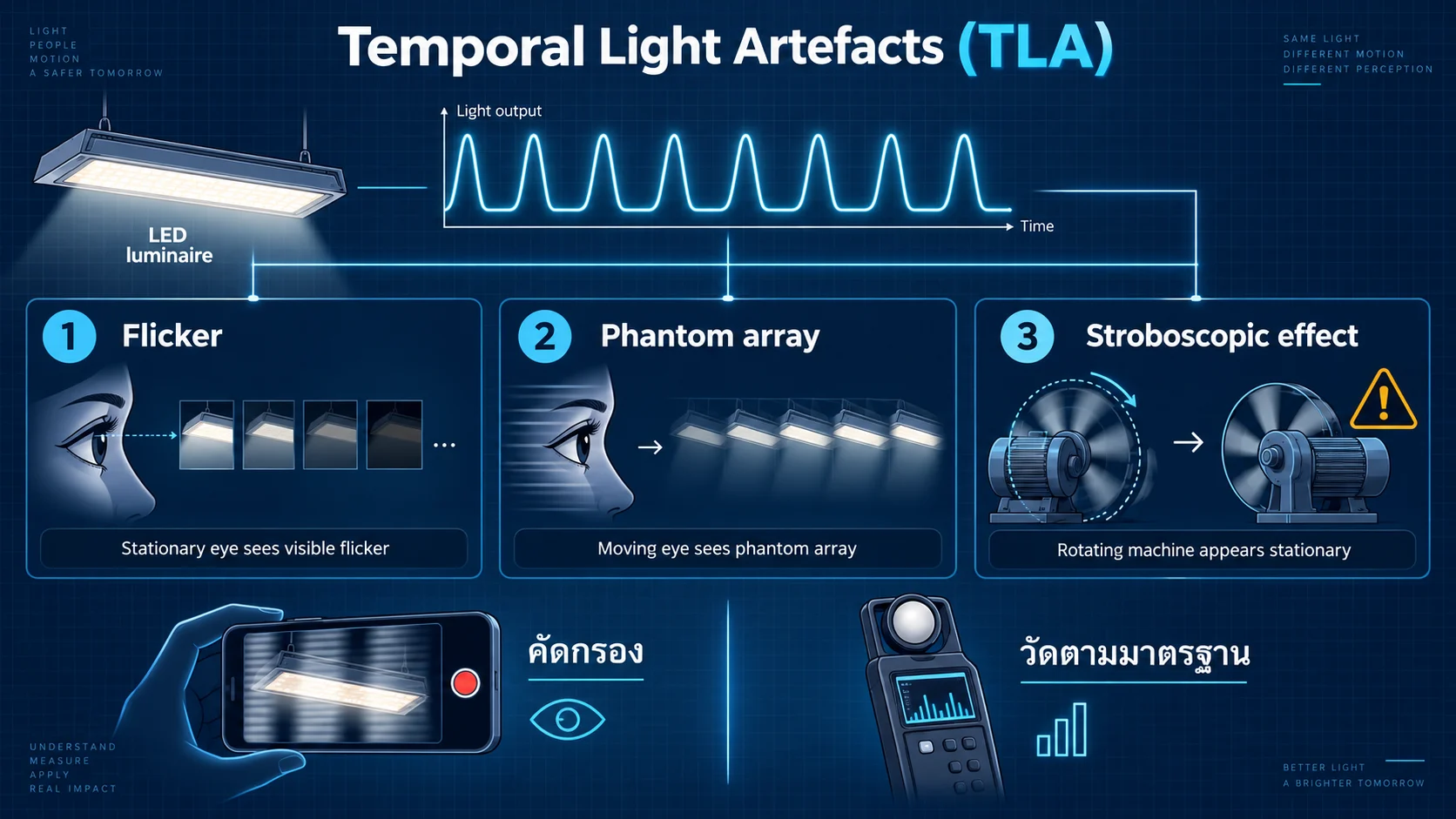
What causes LED flicker?
LED output responds quickly to current, so the driver and dimmer waveform influence temporal light modulation, or TLM. Assess frequency, modulation depth and waveform together. A single percent-flicker limit is not a universal quality test.
DOE Flicker Research discusses PstLM for direct flicker and SVM for stroboscopic effects. Request results at full output and the dimmed levels you intend to use. A “flicker-free” claim should come with test conditions.
Phone-camera bands depend on sensor readout and camera settings; they are not standardised measurements. No visible bands does not prove zero modulation. Read the flicker and stroboscopic-effects guide for a fuller explanation.
What do L70, LM-80 and TM-21 actually tell you?
L70 describes the point at which output is 70% of its initial value. For an initial 1,000 lm, that level is 700 lm. It does not mean the lamp suddenly switches off at the stated hour count, or that it cannot fail sooner.
LM-80 measures lumen and colour maintenance of LED packages, arrays or modules. TM-21 projects maintenance from that test data. The IES position on lifetime prediction explains why component projections cannot, on their own, establish complete-luminaire life.
The DOE luminaire-lifetime guide considers light loss, colour change and system failure. Ask whether a lifetime claim covers the chip or the entire fitting, what operating temperature it assumes, and whether the warranty includes the driver.
A practical LED buying checklist
- Match the task. Decide between general and local lighting; consider output and distribution together.
- Read actual input power. Compare complete-product lm/W under comparable conditions.
- Check colour. Review CCT and CRI; for colour-critical work, request more data and test material samples.
- Match the dimming system. Verify lamp, driver and dimmer compatibility and try the low end.
- Request modulation data. Look for test conditions alongside flicker claims.
- Check installation limits. Confirm enclosure, moisture, temperature and dimensional requirements.
- Read the warranty. Lumen-maintenance life is not the warranty period. Ask about drivers and spare parts.
Where should you start if a lamp flickers, dims or fails?
| Symptom | Starting checks |
|---|---|
| Flicker only when dimmed | Dimmer compatibility, supported dimming range and permitted load |
| Dims or switches off after running | Ventilation, enclosure and driver; have an installer investigate rather than assuming chip failure |
| Not enough light on a desk | Position, beam, obstructions and measured task illuminance before adding watts |
| Colour shifts or mismatched lamps | Model CCT, operating age, thermal conditions and warranty terms |
These checks are starting points, not diagnoses. If there is a burning smell, scorching or a damaged base, stop using the lamp and have the installation checked before fitting a replacement.
Frequently asked questions
Does every LED have a built-in driver?
No. Household lamps often integrate it, while some modules and luminaires use separate drivers. Check the product architecture.
If LEDs turn on instantly, why do output ratings need test conditions?
Emission responds quickly, but output still depends on current and temperature. Stated conditions make ratings comparable.
Are all 10 W LED lamps equally bright?
No. Watts measure electrical input. Compare rated lumens and light distribution as well.
Will an LED switch off after 50,000 hours?
The hour count is meaningless without its criterion and conditions. Gradual light loss and abrupt electrical failure are different outcomes.
Can an LED replace an old lamp in any fitting?
Check base, voltage, size, enclosure and controls. For retrofits involving a ballast, follow the specific lamp’s compatibility and installation instructions.
Continue planning your lighting
- Lumens, lux and watts: formulas and examples
- How to choose E27 bulbs for your home
- Preliminary lighting calculator (Thai interface)
Updated 11 October 2026. This explainer draws on the technical sources below. Calculations are hypothetical examples, not product measurements or certification. See the Lumens Lab methodology (Thai).
Sources and further reading
ทางลัดสำหรับวางแผนแสงสว่าง
เริ่มจากรวมบทความ เลือกเครื่องมือคำนวณ แล้วดูวิธีทดสอบหรือแหล่งเลือกโคมที่เกี่ยวข้อง