No visible flicker does not necessarily mean there is no problem. LED light output can change too quickly to notice when looking directly at a stationary scene, yet still produce repeated images during eye movements, make rotating objects appear slower or stationary, and interfere with cameras. This guide explains the phenomena, the appropriate measurements, and how to select luminaires and drivers using test evidence rather than relying on a “flicker-free” label.
Start with the terminology: Temporal Light Artefacts (TLA)
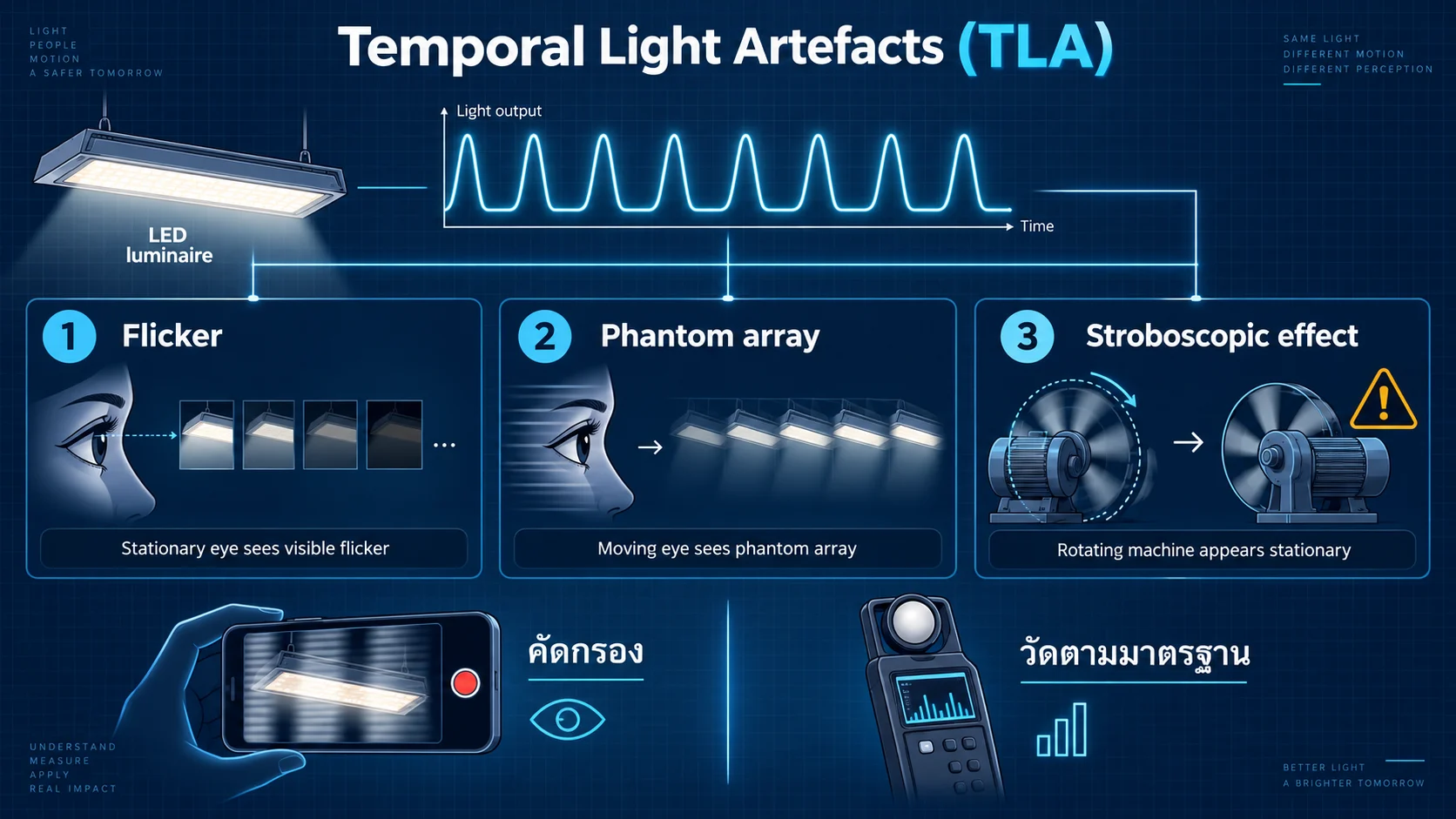
Temporal Light Modulation (TLM) is a change in light output or spectral distribution over time. The visual effects perceived by an observer are collectively called Temporal Light Artefacts (TLA). The CIE terminology distinguishes three principal phenomena that occur under different viewing conditions.
The observer and surroundings are stationary, but the light appears unstable, for example as rhythmic changes in brightness.
Eye movements, or relative movement of a light source, can reveal a series of dots or repeated images, even when no flicker is apparent during steady viewing.
Modulated light distorts the perceived movement of an object, making it appear slower, change direction, or seem stationary.
A 50 Hz AC supply may produce a 100 Hz modulation component after rectification. However, the actual frequency, waveform, and modulation depth depend on the driver circuit, dimming, load, and power quality. Do not assume that every LED flickers at 100 Hz or that frequencies above 1,000 Hz are always safe.
Why LED lamps and luminaires can flicker
LED chips respond very quickly to current. When the driver’s output current rises and falls, light output often follows. Common causes include inadequate ripple filtering, low-cost driver designs, pulse-width modulation (PWM) dimming, dimmer–driver incompatibility, loads below the operating range, voltage dips, and interference from other equipment.
- Good at full output, worse when dimmed: datasheet values measured at 100% output may not represent the entire dimming range.
- The problem remains after replacing the lamp: the cause may lie in the dimmer, driver, control system, or supply voltage rather than the LED chip alone.
- The camera shows bands that the eye cannot see: rolling shutter and camera frame rate interact with modulated light. This is a reason to investigate, not a standardized measurement result.
Percent flicker, PstLM, and SVM measure different things
| Metric | What it describes | When to use it | Limitations |
|---|---|---|---|
| Percent Flicker / Modulation (%) | The depth of light variation based on maximum and minimum output | Simple waveform comparisons under equivalent conditions | Does not adequately account for frequency and waveform; cannot independently predict visibility or effects |
| Flicker Index | The area above the average light level divided by the total area under the waveform over one period | A traditional description of repeating periodic waveforms | Does not provide the frequency-dependent perceptual weighting used by PstLM |
| PstLM | Short-term flicker visibility evaluated using the light flickermeter method | Assessing flicker for a stationary observer in stationary surroundings | PstLM = 1 represents a reference visibility threshold for an average observer, not a guarantee of no effects for everyone |
| SVM | The visibility of stroboscopic effects caused by modulated light | Assessing distortion in the perception of moving objects | SVM = 1 represents a reference visibility threshold for an average observer, not an appropriate design target for every application |
Percent Flicker = (Lmax − Lmin) ÷ (Lmax + Lmin) × 100
For example, if output varies between 100 and 60 units, percent flicker is 25%. What people perceive still depends on frequency, waveform, duty cycle, direct or peripheral viewing, and movement. Do not compare different sources using the 25% value alone without considering their other temporal characteristics.
Numerical criteria to understand
The EU Ecodesign requirements cited in the source article specify PstLM ≤ 1.0 and SVM ≤ 0.4 at full load for mains-operated LED and OLED light sources within scope, with SVM exemptions for certain sources and applications. These values provide a useful procurement reference. They should not be described as an “EN 12464-1 safety standard” or a guarantee that no light-sensitive person will experience symptoms.
Pst in IEC 61000-4-15 evaluates flicker severity resulting from voltage fluctuations using a reference lamp model. PstLM is defined for the light flickermeter method applied to light sources. Use the full symbol and the appropriate product test method in specifications.
Effects on wellbeing, work performance, and safety
CIE notes that visible TLA may reduce performance, increase fatigue, and be associated with acute symptoms such as migraine or seizures in susceptible people. However, headaches, eyestrain, nausea, and difficulty concentrating have many possible causes. This article describes possible associations; it does not diagnose lighting as the definite cause. If symptoms are severe or recurring, seek advice from a healthcare professional and have the actual environment assessed by a qualified specialist.
In factories, the stroboscopic effect poses a hazard that needs prompt attention: rotating shafts, blades, or workpieces can appear slower or stationary, leading people to misjudge whether machinery is operating. Lighting is only one protective measure and must never replace guards, interlocks, lockout/tagout, or machine safety procedures.
Do not approach or touch the machinery. Assume it is still running. Follow the site’s shutdown procedures and notify the responsible person so the lighting and machine safety systems can be checked.
How to test flicker: from screening to measured results
1) Smartphone slow motion — screening only
- Test at full output and the dimming levels actually used. Avoid staring directly at a bright source.
- Record an illuminated light-colored surface, or carefully film the luminaire, at 120 or 240 fps if your device supports it.
- Look for dark bands, pulsation, or clear changes when adjusting the dimmer.
- Record the luminaire, driver, and dimmer models, dimming level, and test time so the comparison can be repeated.
Visible banding depends on rolling shutter, exposure, and frame rate. Conversely, an absence of bands does not prove that PstLM or SVM is low. Phones are useful for identifying unusual behavior and comparing controlled conditions, but should not be used for specification acceptance testing.
2) Instruments and laboratories — checking specifications
Use a photodetector and data acquisition system with bandwidth, sampling rate, linearity, and dynamic range appropriate to the modulation being measured. Calculate results using the relevant reference method, such as the objective light flickermeter in IEC TR 61547-1 for PstLM. CIE TN 012:2021 describes guidance on TLM measurement and reporting, including SVM. Reports should state electrical conditions, temperature, burn-in or stabilization, dimming levels, control method, and relevant measurement uncertainty.
Portable meters can be very useful, but check which methods they use to calculate PstLM and SVM. A “flicker meter” label or a percentage on the display is not enough.
Troubleshooting and luminaire specification checklist
- Request PstLM and SVM results: ensure the lamp or luminaire model, driver, and test conditions match the proposed product.
- Test every important operating point: especially minimum dimming, frequently used levels, and emergency or backup modes where relevant.
- Match the dimmer and driver: use compatibility lists or a physical mock-up. Incompatibility can cause flicker, dropout, and a restricted dimming range.
- Use reference values in context: for products within the relevant scope, use PstLM ≤ 1.0 and SVM ≤ 0.4 at full load as a baseline. Fast-moving tasks or sensitive users may require lower values based on a risk assessment.
- Do not specify only “flicker-free”: require numerical results, the test method, test conditions, and a traceable report.
- Build an on-site mock-up: check performance with the actual cameras, machinery, displays, controls, and power supply before approving the installation for the whole project.
- Address the root cause: replace the driver or dimmer, or adjust the control system, once the cause is confirmed. Distributing luminaires across different phases may reduce combined effects in some cases, but is not a general solution for individual LED luminaires.
Frequently asked questions
Can light modulation have effects even when I cannot see flicker?
Yes, some TLA become apparent during eye movements or when viewing moving objects, and sensitivity differs between individuals. Health symptoms should still be assessed for other possible causes.
Does a slow-motion recording without bands prove the light is flicker-free?
No. It only means that those phone settings did not reveal an obvious issue. Confirming PstLM and SVM requires suitable instruments and calculation methods.
Is percent flicker below 5% good enough?
A percentage alone cannot answer that question because frequency and waveform affect perception. Review PstLM and SVM, or waveform and frequency data, as appropriate to the application.
Does a driver frequency above 1,000 Hz guarantee safety?
No guarantee should be based on frequency alone. Modulation depth, waveform, duty cycle, harmonic components, and the dimming range also matter.
Should SVM ≤ 0.9 be used as the criterion?
Do not present it as a universal limit without identifying its source. SVM = 1 is a reference visibility threshold for an average observer. The cited EU Ecodesign requirements use SVM ≤ 0.4 at full load for sources within scope, with certain exemptions.
Key takeaways
Managing flicker starts with distinguishing the phenomena and choosing a metric that answers the right question. Percent flicker describes modulation depth, PstLM evaluates flicker under stationary viewing conditions, and SVM evaluates stroboscopic effects with moving objects. Phones can help screen for problems, but product selection and acceptance should rely on traceable PstLM and SVM test data, including testing across the dimming range and with the actual installed system.
Further reading: LED flicker and factory safety (Thai), CRI, CCT, and flicker: understanding lighting quality (Thai), and How Lumens Lab selects its sources (Thai).
- CIE TN 006:2016 — Visual Aspects of Time-Modulated Lighting Systems
- CIE TN 012:2021 — Guidance on the Measurement of Temporal Light Modulation
- IEC TR 61547-1:2020 — Objective light flickermeter and voltage fluctuation immunity test method
- Commission Regulation (EU) 2019/2020 (consolidated) — Ecodesign requirements for light sources
- IEEE 1789-2015 — Recommended Practices for Modulating Current in High-Brightness LEDs
Editorial review: The Thai source and reference links were reviewed by the Lumens Lab editorial team on September 29, 2026. English translation: October 11, 2026. This article is for education and preliminary specification. It does not replace the full standards, medical assessment, or a machinery safety assessment by qualified professionals.
ทางลัดสำหรับวางแผนแสงสว่าง
เริ่มจากรวมบทความ เลือกเครื่องมือคำนวณ แล้วดูวิธีทดสอบหรือแหล่งเลือกโคมที่เกี่ยวข้อง