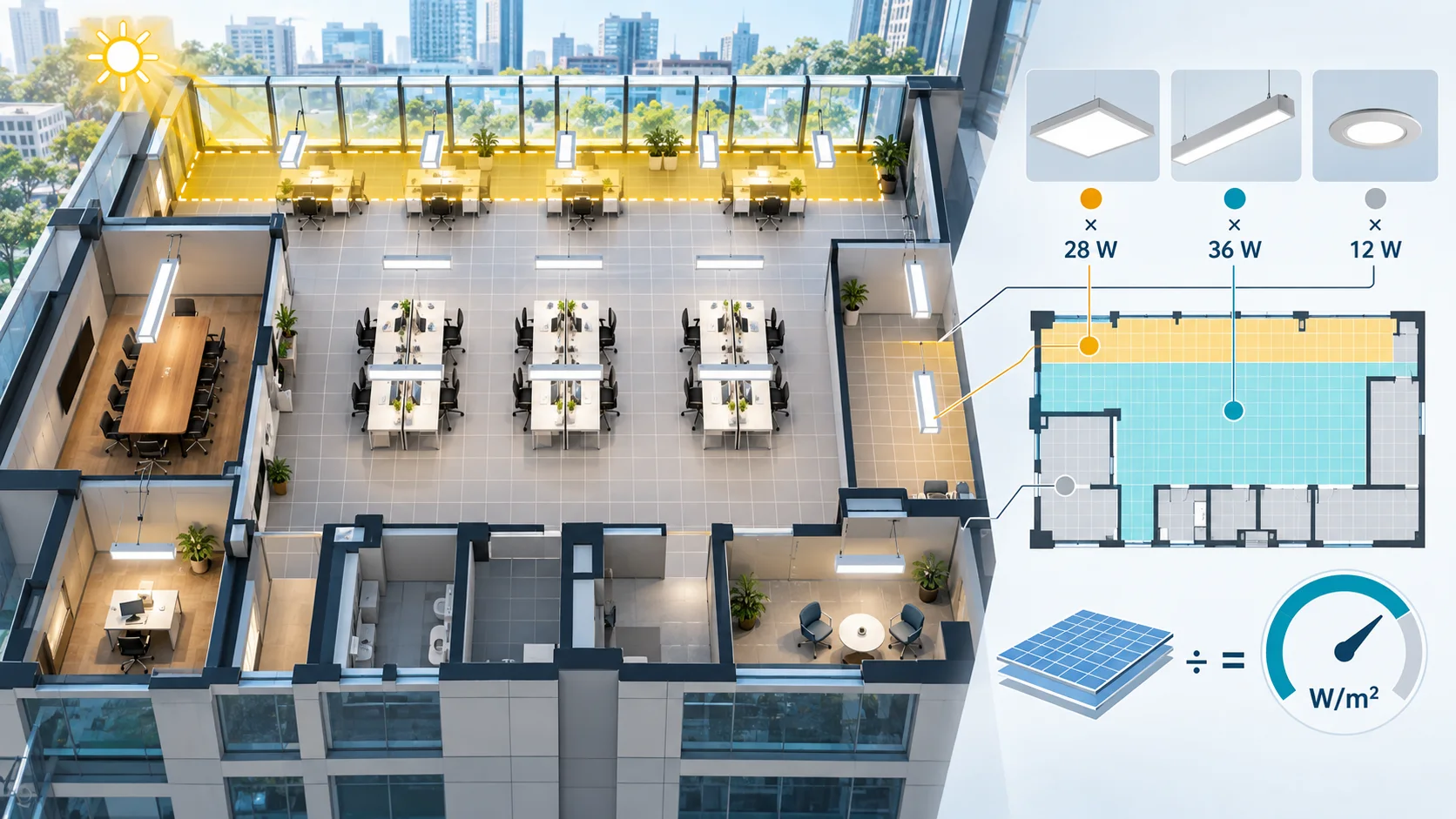
Thailand’s Building Energy Code (BEC) limits installed lighting power per unit of floor area, or LPD, to control building energy use. Meeting the LPD limit does not guarantee adequate or good-quality lighting. A lighting design must therefore check both the permitted electrical load and visual performance, including illuminance, uniformity, glare and colour quality.
What is BEC?
BEC stands for Building Energy Code. In Thailand, it provides a framework for assessing whether the systems in regulated buildings are designed to use energy efficiently in accordance with the applicable regulations. It covers more than luminaires: its main elements include the building envelope, air conditioning, electric lighting, hot-water systems and overall building energy use.
For lighting design, BEC sets the maximum permitted installed lighting power according to building type and the area served. The aim is to prevent unnecessarily high electrical loads at the design stage, before construction or alteration and submission to the relevant authorities.
In simple terms: BEC is the building’s energy rulebook; LPD is one of the metrics used to assess lighting compliance.
What is LPD, and what does it tell us?
LPD stands for Lighting Power Density: the installed electrical power of a lighting system per unit of floor area, expressed in watts per square metre (W/m²). It tells us how many watts of installed lighting serve each square metre, rather than how much light reaches a surface.
For example, an office area of 100 m² with 800 W of installed lighting has an LPD of 8 W/m². This is below the office limit of 10 W/m², but illuminance, uniformity, glare and colour quality must still be checked separately to confirm that occupants can see comfortably and effectively.
A low LPD does not necessarily mean low light levels. Efficient luminaires, suitable light distribution and a well-planned layout can provide sufficient light with less power. Conversely, a system that meets the LPD limit may still be dim, uneven or glaring if its luminaires are poorly positioned.
BEC lighting power density limits at a glance
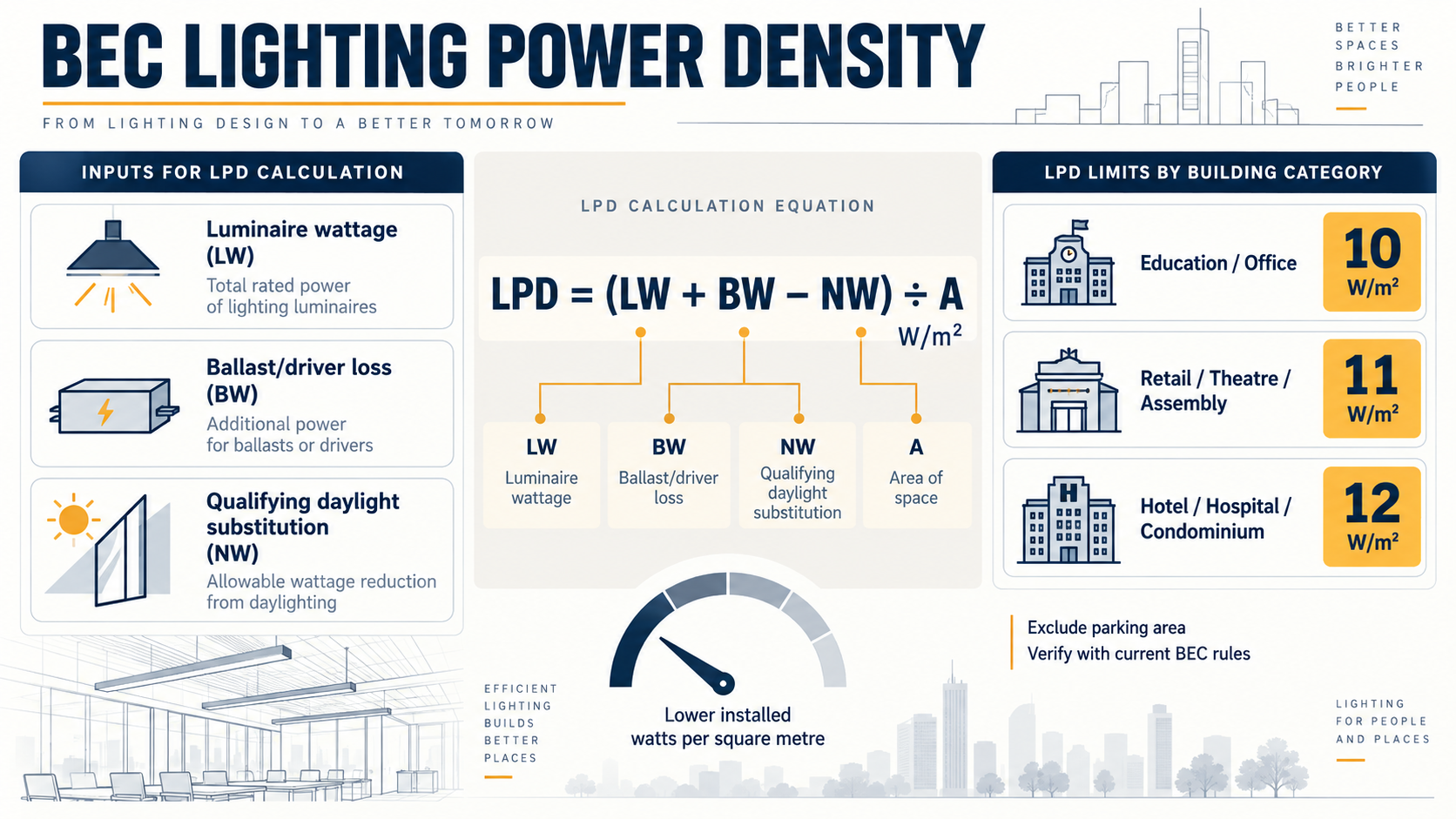
Lighting Power Density is installed lighting power averaged over the applicable usable floor area, in W/m². According to the BEC handbook issued by Thailand’s Department of Alternative Energy Development and Efficiency (DEDE), parking areas are excluded from the building area used to calculate LPD.
- 10 W/m²: educational buildings and offices.
- 11 W/m²: department stores or shopping centres, theatres, service establishments and assembly buildings.
- 12 W/m²: hotels, healthcare facilities and condominium buildings.
These figures refer to the Ministerial Regulation B.E. 2563 (2020) and related notifications. Check the applicable edition of the regulations and the classification of the actual project before using them.
Which buildings are covered by BEC?
BEC covers nine building types: healthcare facilities, educational buildings, offices, condominiums, assembly buildings, theatres, hotels, service establishments, and department stores or shopping centres. DEDE’s BEC website identifies a scope of buildings with an area of 2,000 m² or more. Whether a project falls within that scope depends on its type, size, construction or alteration work, and the requirements applied by the permitting authority at the time of submission.
The BEC formula for calculating LPD
The BEC handbook gives the following calculation for area i:
LPDi = (LWi + BWi − NWi) ÷ Ai
| Variable | Meaning | Supporting evidence |
|---|---|---|
| LWi | Total lamp power in area i (W) | Luminaire schedule, electrical drawings and manufacturer power data. |
| BWi | Total ballast power losses in area i (W) | Ballast or control-gear data, identified separately from lamp power. |
| NWi | Lighting power replaced by daylight, subject to BEC conditions (W) | Opening details, control-system drawings and evidence that the daylight requirements are met. |
| Ai | Total usable floor area of zone i (m²) | Architectural drawings from the same revision used for the assessment submission. |
To combine several areas, use an area-weighted average:
LPD = Σ(Ai × LPDi) ÷ ΣAi
For LED luminaires whose stated total luminaire input power already includes driver losses, use that figure consistently and do not add those losses again. If the documentation lists LED-module and driver power separately, show clearly in the schedule that each component is counted only once.
Worked example: office lighting power density
Assume an office area of 1,500 m² contains 200 LED luminaires, each with a total input power of 60 W, and no NW allowance has yet been substantiated under the BEC conditions:
- Total installed power = 200 × 60 = 12,000 W.
- LPD = 12,000 ÷ 1,500 = 8.0 W/m².
- Office limit = no more than 10 W/m².
This example meets the LPD limit with a margin of 2.0 W/m². The design must still deliver appropriate illuminance, uniformity, glare control and colour quality for the actual work. Do not remove luminaires merely to meet the power limit if doing so leaves the space insufficiently lit.
NW is not an automatic deduction
A common mistake is to deduct wattage as NW simply because a space has windows or a photosensor. The BEC handbook ties daylight substitution to specific conditions, including opening geometry and proportions, glazing properties, the daylit area and luminaire controls. Claim NW only when the supporting documents and calculations demonstrate that the conditions are satisfied. If this cannot yet be confirmed, use NW = 0 for a conservative preliminary calculation.
How to prepare an easy-to-check lighting load schedule
- Divide the building into use areas: identify floors, zones and building types consistently with the architectural drawings and BEC submission.
- Define area boundaries: use the same drawing set for every area schedule and separate parking areas in accordance with the BEC definition.
- Count luminaires from the latest drawings: list each luminaire code, quantity, input power per unit and total power.
- Check how power is counted: distinguish separate lamp-and-ballast ratings from total LED luminaire input power to avoid counting drivers twice.
- Record NW separately: include only areas with evidence of eligibility, citing the relevant drawings and control method.
- Calculate each area before combining results: this helps identify unusually high loads and target design changes.
- Check using BEC Web-based: use DEDE’s assessment tool and have a certified assessor review the results when required for the project.
How to reduce LPD while maintaining lighting quality
- Select for system efficacy and photometric performance: high lm/W helps, but check light distribution and IES/LDT files to ensure the lumens reach the task plane.
- Improve the layout as well as the wattage: suitable spacing, mounting heights and aiming can often reduce luminaire quantities while maintaining uniformity.
- Use task–ambient lighting: provide extra light where detailed work requires it instead of raising illuminance across the entire area.
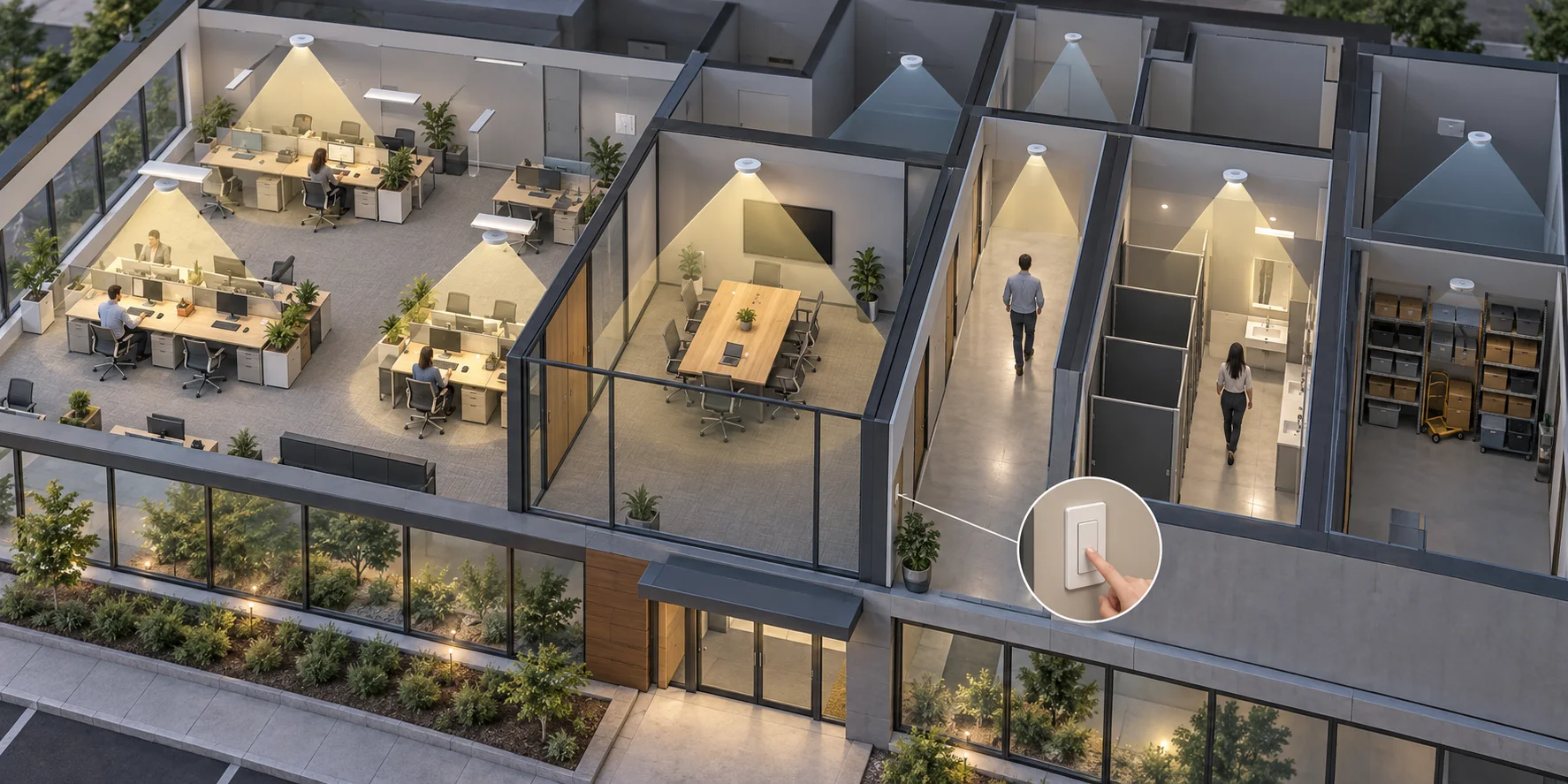
- Use daylight and occupancy controls: these reduce actual energy use and can support BEC objectives when designed to the applicable conditions. Commission sensors and setpoints after installation.
- Design for maintained illuminance: choose a maintenance factor that reflects dust, luminaire ageing and cleaning intervals, rather than checking only initial performance.
Common errors that distort LPD results
- Using “equivalent wattage” from the packaging: use actual input power, not a claim about the wattage of a conventional lamp it replaces.
- Using LED-chip wattage: this may omit losses in the driver and other equipment.
- Adding driver losses twice: this happens when losses are added to a datasheet value that already represents total input power.
- Using mismatched drawing revisions: luminaire quantities and floor areas must come from coordinated revisions.
- Claiming daylight deductions without evidence: windows alone do not automatically justify NW.
- Treating parking areas incorrectly: the handbook excludes parking areas from building LPD calculations.
- Checking only the whole-building average: an average can hide unusually high loads, so review individual zones and floors too.
Checklist before submitting a BEC design
- Confirm that the building type and size match the rules in force at submission.
- Use coordinated revisions for the area schedule and lighting drawings.
- Support every luminaire power rating with manufacturer data or a datasheet.
- Count driver and ballast power only once.
- Separate parking areas according to the BEC definition.
- Provide complete drawings and calculations for every NW claim.
- Recheck area-specific LPD values and the weighted average.
- Confirm illuminance and uniformity with lighting calculations or simulations.
- Retain photometric files, datasheets, load schedules and the BEC report.
- Include a plan to commission the controls after installation.
Frequently asked questions
Is an LPD far below the limit always better?
It is better in terms of installed power, but it does not guarantee lighting quality. Check visual performance, comfort and safety. A design that saves watts by providing insufficient light is incomplete.
Does dimming reduce LPD?
LPD is based on installed power using the method specified by BEC. Do not simply reduce installed wattage by an assumed dimming percentage from an operating schedule. Controls reduce actual energy use, and some arrangements may relate to NW eligibility, which must be demonstrated under the relevant criteria.
Should decorative luminaires be counted?
If they form part of the installed lighting system in the area, include them in the lighting schedule and check how the regulatory scope applies. Do not omit them merely because they are not the main lighting.
Can this article replace a certified BEC report?
No. It helps prepare information and perform an initial reasonableness check. Projects within the regulatory scope must follow the required procedures and use assessors with the qualifications specified by the responsible authority.
Further reading on Lumens Lab
- Daylight harvesting: photosensor design and daylight zoning (Thai)
- Occupancy and presence sensors for lighting control
- Preliminary lux and luminaire quantity calculator (Thai)
- How to interpret test results and assess LED luminaire quality (Thai)
References
- DEDE — Ministerial Regulation and Notification of the Ministry of Energy on Building Energy Code (BEC)
- DEDE — BEC ministerial regulations and related notifications
- DEDE — Legal requirements for energy-efficient buildings
- DEDE — Criteria and calculation methods for building design
Source content reviewed: 29 September 2026. English translation: 12 October 2026. This article provides general technical information and does not replace a legal determination or design certification by a qualified assessor.
อ่านต่อเรื่องมาตรฐานและการทดสอบ
ถ้าต้องใช้ค่าแสงเป็นเกณฑ์ออกแบบหรือยื่นตรวจสอบ ลองดูหน้าที่เกี่ยวข้องต่อจากนี้